Send money like a text — privately.
The confidentiality and reach layer for money on Robinhood Chain.
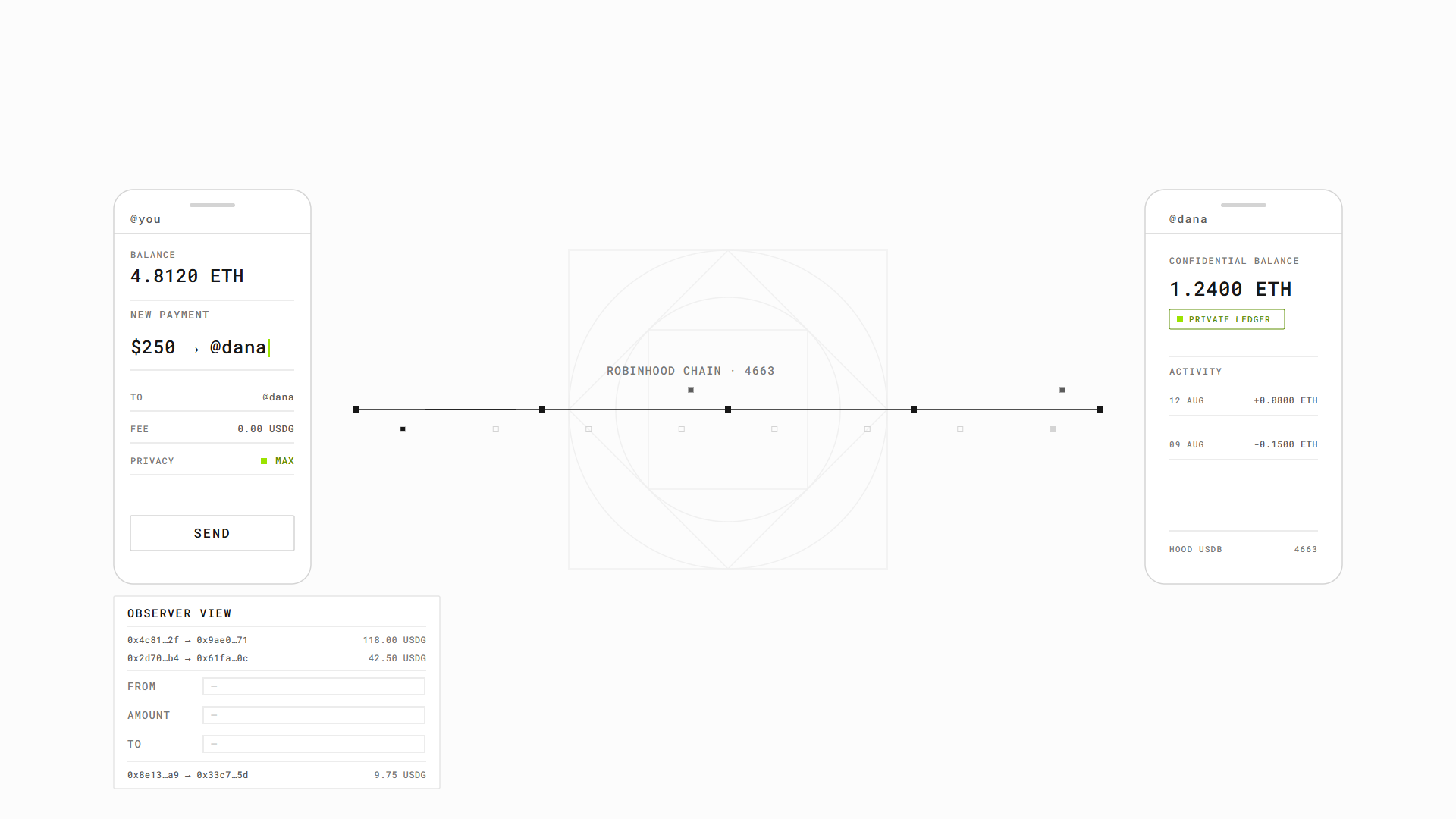
Stablecoins solved speed and cost. They did not solve exposure, and they never solved reach.
Hood USDB is the confidentiality and reach layer for money on Robinhood Chain. Your balance moves off your own address into a pooled reserve, deposits are split and routed so there is no on-chain edge back to you, and you spend by @username, by a one-time link, or through an agent working under limits you set.
Stablecoin payments today are Exposed.
Every balance and every counterparty on a public L2 is legible to anyone holding a block explorer. And a transfer can only reach someone who already owns an address — which rules out nearly everyone you would actually want to pay.
Fast rails, zero privacy, no reach.
A public L2 broadcasts every payment by default, and a token transfer can only land on an address that already exists. Both are dealbreakers the moment real money and real people are involved.
Exposure
Every balance and every payment is legible. Anyone can profile what you hold, who you pay and how often.
DefaultReach
You can only pay an address that already exists — which rules out nearly everyone you would actually want to pay.
BlockedOnboarding
Receiving crypto normally means an app install, a seed phrase written on paper, and a working theory of gas.
BrokenThe price of privacy
Existing tools are all-or-nothing and expensive, with no way to trade confidentiality against speed and fee.
RigidWhat is visible on-chain today
Dark bars measure a public L2 as it stands. The two lime extensions mark the only figures Hood Hood USDB changes — reach, and the ability to choose.
Three parts. One payment that behaves like a message.
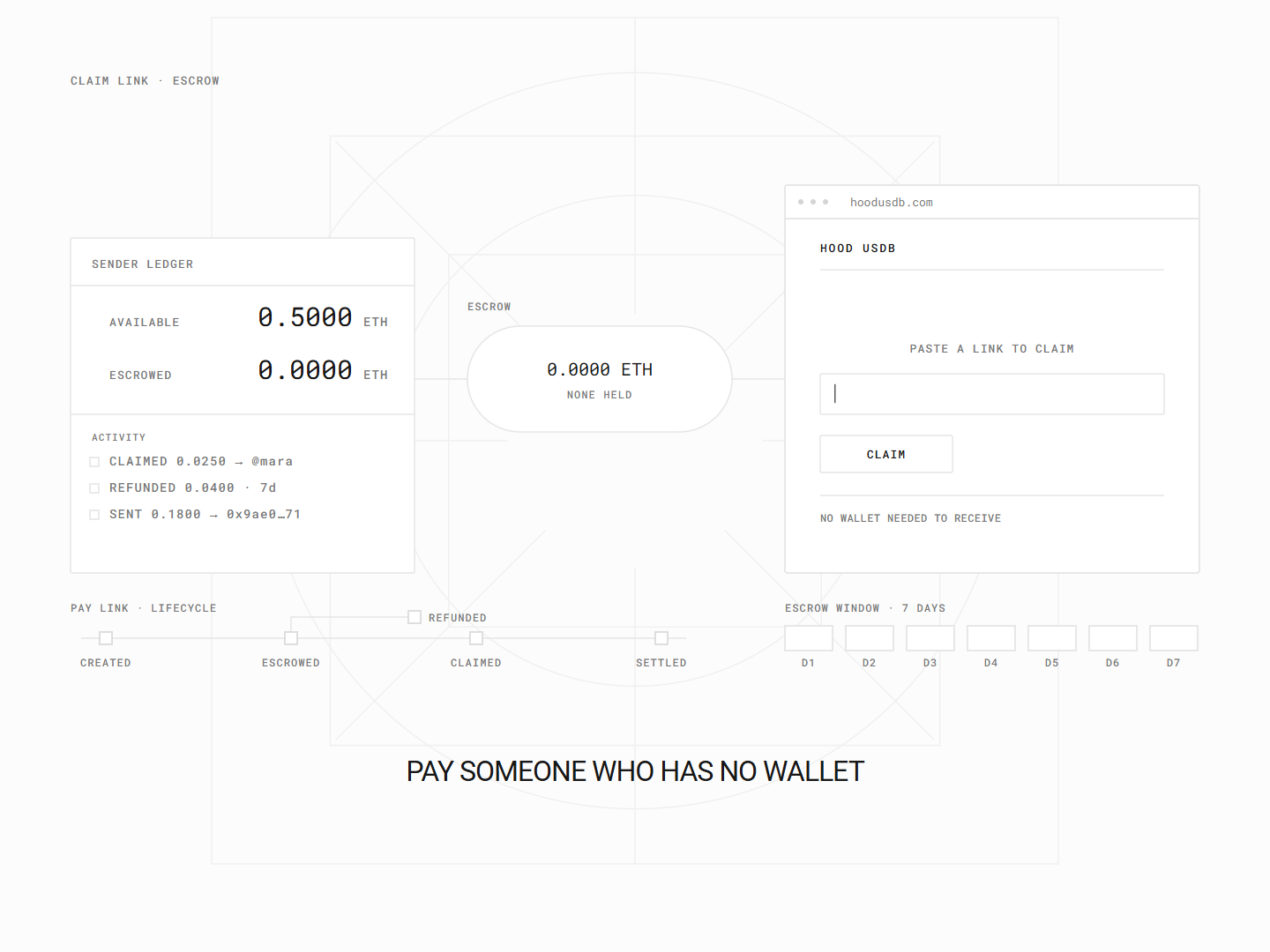
Pay anyone with a link
[01]Attach an amount to a one-time link and send it however you like — message, email, DM. The funds sit in ledger escrow until the recipient claims them, either into an account or straight out to any address they type. No wallet is needed to receive, no app to install, and the relayer covers the gas. Nothing claimed in seven days comes back to you automatically.
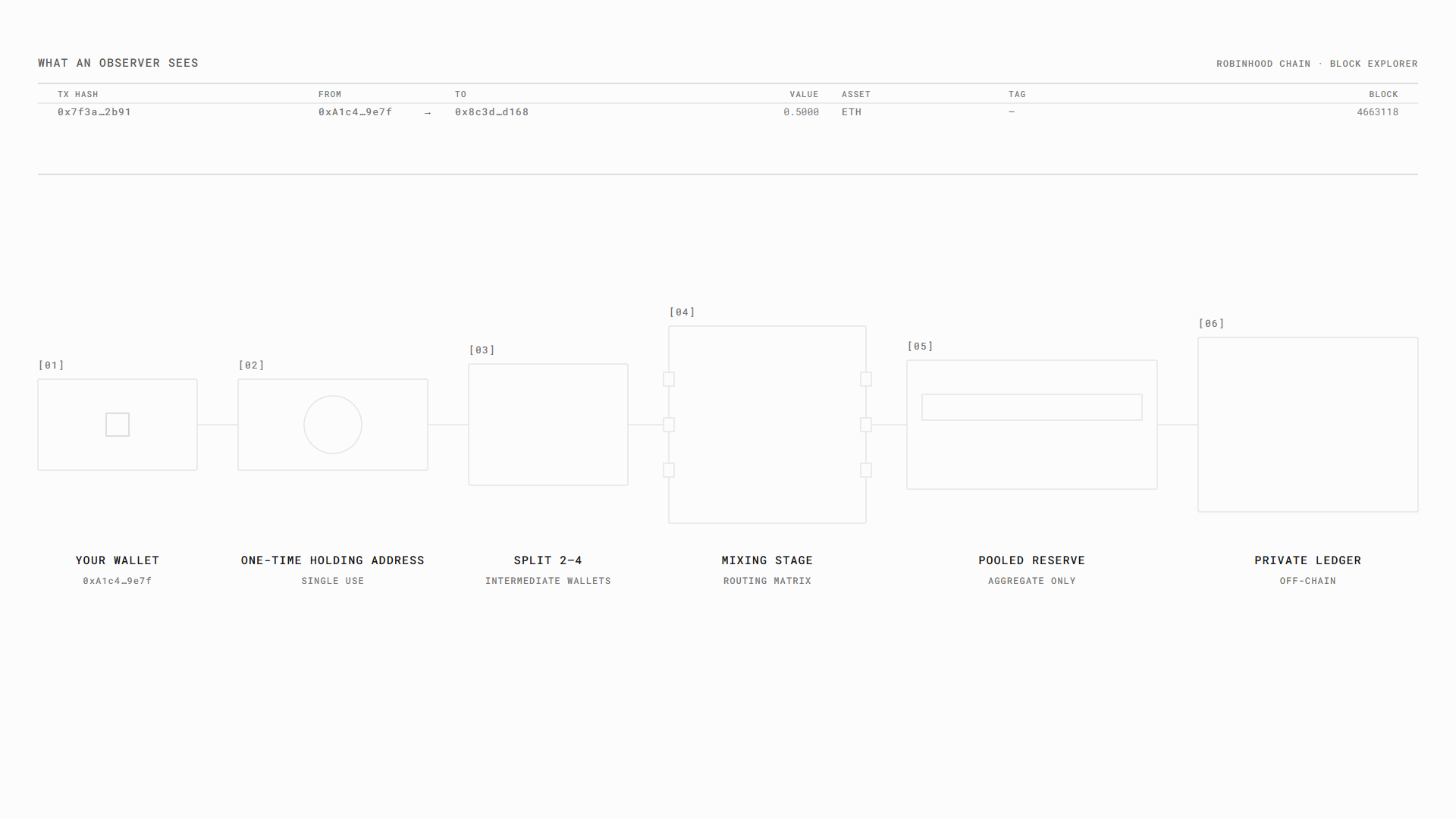
Confidential by default
[02]A full-privacy deposit lands in a fresh one-time holding address, then moves on in randomized portions across staggered hops and through a mixing stage before joining the pooled reserve. Your spendable balance is tracked on the private ledger, and the relayer signs every payout — so your own address never appears as the sender.
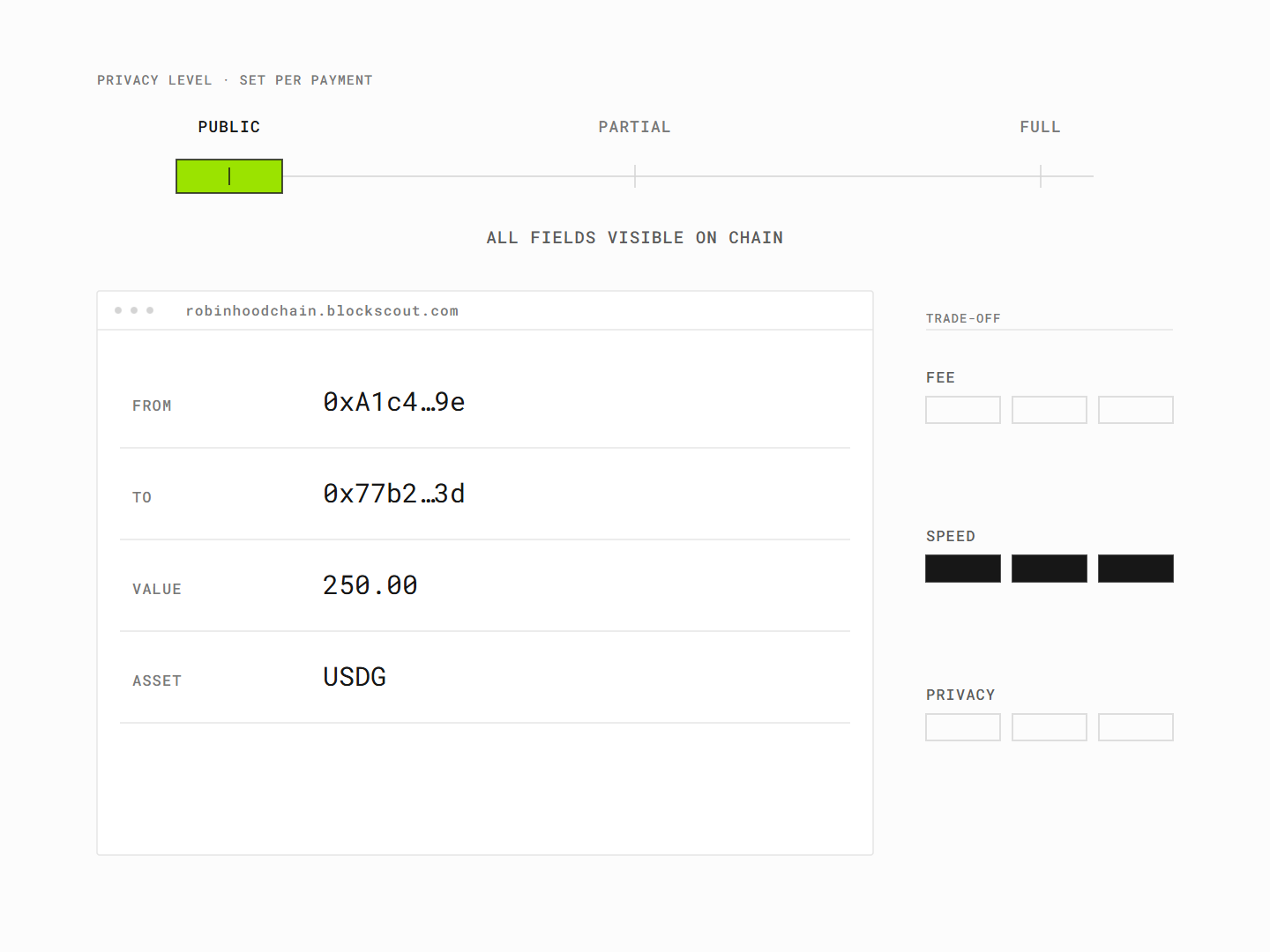
Privacy is a dial, not a switch
[03]Choose per payment. Full routes ETH through the entire pipeline — strongest separation, highest fee, slowest. Partial sends USDG into the shared pool, so the deposit is visible but the spending is decoupled. Public is a plain transfer, cheapest and fastest, and we say plainly that it is fully visible. Rent can go Full. Splitting a dinner bill does not have to.
Settled in a regulated dollar
[04]Everything lands on Robinhood Chain, an Arbitrum Orbit L2 live since June 30, 2026. USDG is the dollar leg — Paxos-issued, MAS/MiCA-regulated, 1:1, and part of the Global Dollar Network. First-come-first-served sequencing means there is no gas auction to front-run, which matters more for a privacy protocol than it does for most.
A payments app where the crypto disappears.
Pick a recipient, pick an amount, sign once. The pool, the routing and the ledger stay where they belong — underneath. Your wallet is your identity, an optional @username makes you payable by name, and one toggle hides every figure on screen when someone is looking over your shoulder.
See how payments workSoftware that can pay, under limits it cannot argue with.
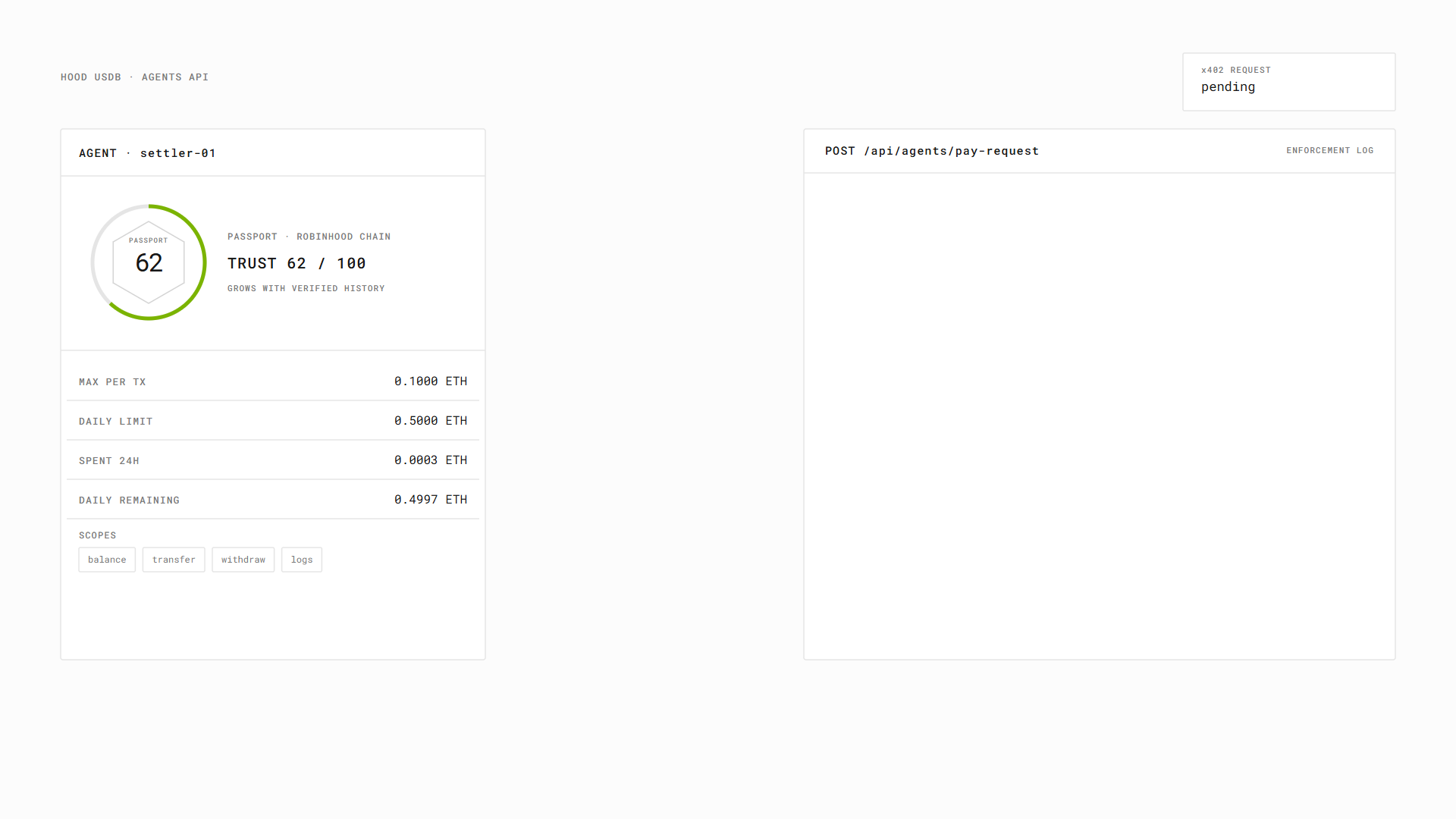
An agent gets a scoped key and a spending policy: a per-transaction ceiling, a rolling 24-hour limit, recipient allow and block lists, time windows. Every call is checked server-side before anything moves, and every settlement returns a signed receipt the payee can verify without asking us.
An agent holds a scoped API key, never your private key. Every call is checked against this policy server-side and written to a spending log — allowed, blocked, completed or failed, with the reason. Pause or delete the agent and enforcement is instant.
curl -X POST https://hoodusdp.com/api/agents/transfer \
  -H "X-Agent-Key: <key>" \
  -d '{ "to": "@alice", "amount": 0.42, "token": "ETH" }'
403
{
"error": "blocked_by_policy",
"rule": "max_per_tx",
"limit": 0.1,
"requested": 0.42
}Over the per-transaction limit. Refused before anything moves.
Three roles. Each with a reason to be here.
Pay anyone, at the privacy you choose
Rent, payroll, a cross-border payout, or splitting a bill — each one at its own level. Send to a @username, an address, or a link that reaches someone who has neither.
A link, then money, in seconds
Open the link in any browser. Connect a wallet you already have, or just paste an address and take the payout. No install, no seed phrase, no gas — the relayer covers it.
Lower fees now, protocol share next
Holding HUSDB moves you up the withdrawal fee tiers today. Staking for a share of protocol fees, governance over fees and privacy parameters, and USDG reserve yield share follow.
Five layers between your money and a block explorer.
A pool keeps balances off your address. Splitting and a mixing stage break the trail. The relayer signs every payout. Links remove the wallet requirement. And every one of them settles in a regulated dollar on a chain built for regulated finance.
A one-time link carries an amount and nothing else. The funds sit in ledger escrow until someone claims them, to an in-app account or to any address they type. Nothing claimed inside seven days returns to the sender automatically.
Your funds are held in a shared pool contract rather than on your own address. An observer reading your wallet learns the pool exists and nothing else; the split between accounts lives on our ledger.
A full-privacy deposit lands first in a fresh one-time holding address, then moves on in two to four randomized portions across staggered hops and through a mixing stage. Amounts are randomized or rounded to fixed denominations so the parts cannot be recombined by arithmetic.
Withdrawals and transfers are signed and broadcast by the protocol relayer, funded from the pool. Your address never appears as the sender of the outbound transaction, and a recipient needs no ETH of their own.
Everything settles on Robinhood Chain, an Arbitrum Orbit L2 live since 30 June 2026. USDG is the dollar leg — Paxos-issued, MAS/MiCA-regulated, 1:1. First-come-first-served sequencing means there is no gas auction to front-run, which matters more for a privacy protocol than for most.
We say private, not magic.
Every other section on this site is an argument for the protocol. This one is the argument against it, written by us, at the same size as the rest.
Operational privacy, not cryptographic
This is privacy against on-chain observers, produced by pooling and routing. It is not a cryptographic guarantee. FHE-encrypted balances and an on-chain proof system are on the roadmap and are not shipped.
You are trusting a pool operator
You sign every deposit and withdrawal, and we never hold your keys — but your balance sits in a reserve Hood USDB operates and is recorded on our ledger, so withdrawals are processed by our backend rather than claimed from a contract. That is a trust assumption, and you should weigh it.
Off-chain adversaries are out of scope
Someone holding data that never touches the chain — an exchange record, a seized device, a legal order — is outside what routing can address. We would rather name the boundary than let you assume there is not one.
Public means public
The Public level is a normal token transfer and is fully visible, exactly like any other. We do not call it Standard, because that would be a euphemism, and a euphemism here would cost more than it buys.
Rails, then reach, then tiers, then scale.
Four phases, shipped in that order. What the docs describe as working is marked shipped and written in the present tense. What is not shipped sits in phase four and is named.
Levels — in progress
Public, Partial and Full selectable per payment, relayer payouts for origin protection, and the fee flywheel — collection, buyback on Robinhood Chain DEXs, permanent burn.
- 01Privacy level per payment
- 02Protocol relayer v1
- 03FeeCollector + buyback
- 04HUSDB fee schedule
Send money like a text. Privately.
Connect a wallet, sign one message, and make your first private payment on Robinhood Chain.